Wednesday, 8 August 2012

The Berzack Bat Mitzvah


The celebrations began on Friday, with family members from the United States, United Kingdom, and Australia and all over South Africa arriving throughout the day. After welcome drinks, some enjoyed a relaxing afternoon while others had an educational trip to Emdoneni, the cheetah sanctuary. After freshening up, everyone reunited at Tree Lodge where they had Shabbat and prayers followed by a short welcome speech before a kosher buffet dinner was served.

Saturday commenced with the family gathering by the pool at Safari Lodge, where refreshments were served. The typical dry winter backdrop was brought to life by the eventful flurry of children and elegantly set tables, adding an entertaining atmosphere to the early afternoon’s pre-celebration.  


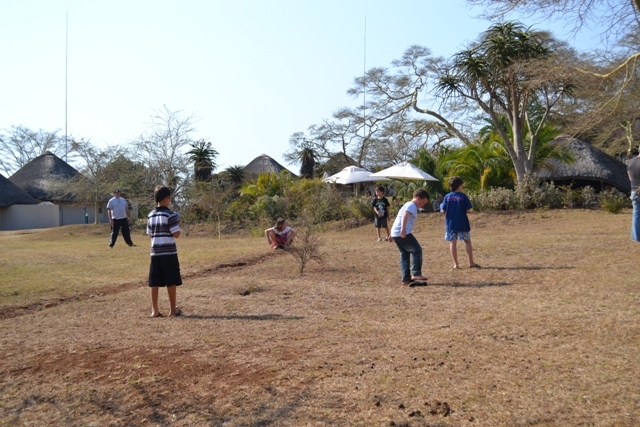
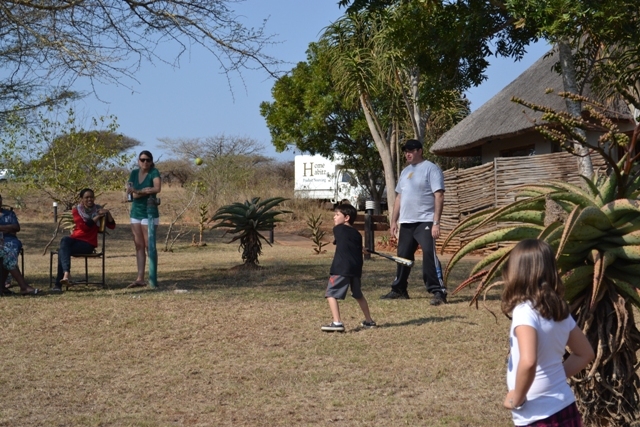
A quick game of baseball entertained both the spectators and players, working up a healthy appetite before lunch.
A delicious cold lunch was served alongside one of the many watering holes we have surrounding Safari Lodge. The bare weather stricken branches provided sufficient shade as the family enjoyed the buffet style lunch of Brisket, Cold Meat, Salads and a selection of Fruit. 


Zulu dancers provided a truly South African experience with their beating drums and traditional costumes. After a short demonstration of their refined skills, the dancers selected members from the somewhat astonished audience to join in and truly experience Africa first hand by participating in a traditional Zulu dance. The younger family members proved to be truly remarkable, with their eagerness and uncanny flexibility, and at times even giving the Zulu dancers a run for their money.


The main celebration took place in the Boma, where tranquil candles lead the way to a welcoming fire in the centre. Blue lanterns, candles and serviettes added a splash of colour to the Boma that was warmly lit with soft fairy lights that gently draped the surrounding walls of the Boma. 


The guests soon arrived and before long they came sweeping into the Boma, in their elegant attire gathering around the crackling fire, warming up before celebrations begin. After all the formalities, a lovely montage of a beautiful girl, who has now become a woman, was viewed. After which every one loosened up on the dance floor, before enjoying a kosher buffet dinner. 


The toasting of marshmallows over a sizzling fire drew the night to a close and a beautiful evening shared between family and friends, who united under an African sky to mark such a special occasion came to an end.


Monday, 6 August 2012

Neither Lion nor Ant


Many previous visitors to Ubizane might have noticed numerous Circular formations in the sand around the lodge and on the road from Zululand Safari Lodge to Zululand Tree Lodge.
These circular formations are quite literally death traps in the insect world, well for Ants at least. 


The Larvae of the Antlion digs a pit in loose soil in spots where it will have shelter from rain, and warmth from the sun. This funnel shaped crater in the earth serves as deadly trap for ants or any other small creature passing by.
The sides of the pits are prepared with fine sand or soil particles which make it difficult for small creatures to escape, once they have fallen inside.
With open jaws the Antlion waits patiently for a tasty snack to fall into the pit and into his lingering jaws of the “Doodle Bug”.  The Antlion Larvae is also referred to as the “Doodle Bug” due to the strange drawings on the sand, which it makes during its search of a place to make its pit.  


Ruffling some Feathers


Those of you, who have read our blog, know that we recently received 7 elegant Ostriches. We were very excited and welcomed them with open arms.
Having had time to settle in, we are learning that each of them have their own unique personalities! Strangely it is always the females that are getting themselves in a sticky situation or being very inquisitive.  


A few days ago, our (what seems to be regular) female ostrich decided she will spend the afternoon basking in the sun at Tree Lodge pool area. She spent a few minutes milling around selecting her preferable location, before settling nearby our pool lounges by the bar.  


She seemed quite relaxed standing near one of the umbrellas, and at one stage she even had her eyes closed, catching a mid afternoon snooze perhaps?


After a good few minutes of some ‘down time’ she moved off to her next location of choice, the Managers office!
Here she constantly peers in through the window just to make sure that everyone is doing their work.  


Cocktail Ants of Ubizane:

Many of the trees here at Ubizane have Cocktail Ant’s Nest in them. If you haven’t seen them in the Ubizane trees, next time you are here look out for large mass of what looks like mud in the tree branches.


Cocktail Ants get their name from the behavior they exhibit once threatened. The cocktail ant will raise its abdomen over its head when alarmed or disturbed, they are also known to excrete a sticky white rather unpleasant smelling liquid from the gland at the tip of their abdomen.


Feeding on sugary substances and building their nests out of vegetative matter, Cocktail Ants are arboreal, meaning they live in trees. The nest itself is made up of chewed up vegetative matter that is mixed with a secretion from the jaw glands of the worker ants, it is very thin and black in colour due to the secretion from the jaws.


Cocktail Ants will generally build their nest in the same trees that birds nest in, and form a mutualistic relationship. This is an association between organisms of two different species in which each member benefits. In this way when the birds protect their nest, they in turn protect the ants nest as well.  


Friday, 27 July 2012

Curious Creatures


Giraffes are always regarded as such elegant creatures, with their long slender legs and their stretched out necks, not to mention their long eyelashes that will make any women envious. At Ubizane we are regularly treated to up close experience with these giants of the bush. 
One of their frequent ‘hangouts’ is the Ubizane parking area, where you truly get a grasp on their immense size, when they stand next parked car.
Inquisitively peeping around the bushes at the days happenings of the lodge, it seems with every day that passes the tower of Giraffes get a little bit braver.    


Giraffes are not all that seem congregate at the Ubizane Parking area, Vervet monkeys also tend to favour the shaded area. As many of you who have visited us before know, the vervet monkeys can be particularly mischievous, and all too often they find themselves in quite a pickle!
This particular monkey thought a guest’s car would make a fine resting place after the mornings gallivanting. You can only image the mischievous events that he is busy planning!   


Being tucked away in the bush, the parking lot is not the only hot spot for glimpsing game, Throughout the Ubizane property there I always something going on!
Whether it is birds scourging around in the leaf litter, or a shy Nyala having an afternoon drink from one of the many ponds on the property; to even a Terrapin basking in the late afternoon sun!
At Ubizane you are guaranteed to never have a dull moment! 


Thursday, 26 July 2012

The Heart of a Lion


 The winter air brushed against our cheeks, while the Ubizane Land Rover chugges through the Hluhluwe Umfolozi Park, the dry winter bush creating an ideal game viewing opportunity.
Slowing down to get a better viewing of a Rhino and her calf, a rustle in the nearby grass catches our attention but in the hazy morning light, it is difficult to get a clear view. 


Then we see it! Lions, 5 of them! Perched on the edge of our seats with anticipation, we eagerly watch them as they stealthily walk through the bush, without stirring a single blade of grass. Walking with purpose, the lions seem to be on the hunt moving off in the direction of the Rhino and her calf. Surely they are not the brave?   


At first, the female in the front gives the Rhino a cautious wide birth, wary of her colossal size and strength. Ears pricked and facing in the direction of the approaching lions, the young calf bravely stands guard alongside its mother. The youngster’s tensions begin to rise as 1 lion gets a bit too close for comfort; crouched low in a stalking posture the lion ambles on, in front of the Rhino. 


Not having any of this the mother rhino raises her immense head, almost as a warning to the inexperienced lioness. Still not catching the hint, the mother and her calf casually walk towards the lioness, almost as if to give ‘Back off or else...’   stare. Scurrying out of harm’s way, the lioness’s hasty retreat comes to a halt not too far from the Rhino and her calf, and casually looks back at the meal that could have been.  


Wednesday, 25 July 2012

Night Life at Ubizane


Coming to the bush means different things to various people. There are some who simply wish to escape the hustle and bustle of city; others are in search of the Big 5 and some who are simply astonished by the wide open spaces, fresh air and breath-taking views. Here at Ubizane, we are fortunate enough to cater to all of the above. Situated within a 1200 hectare reserve, we are a mere 4 kilometers from Hluhluwe Town and a stone throw away from Hluhluwe Umfolozi National Park. 


As the sun sinks, your African experience doesn’t end, a whole different world awakens from its deep slumber.
The birds are the first to kick start the evening’s hustle n bustle with their loud ‘chitter chatter’ and frantic foraging for that last tasty snack, before the sun bids its final farewell.  


The vast African sky is probably the most noticeable feature at night, countless stars scattered across the sky sparkling with pride. At first glance the vast night sky appears to be just an accumulation of tiny lights all crowded together. Allowing your eyes time to adjust to the mysterious darkness that now cloaks the earth, you soon start to see numerous constellations.  


While you lose yourself in the sheer beauty of the night sky, the gentle tune of a cricket and the glisten of a Nyala’s reflection at a moonlit waterhole a few meters away, distract you momentarily from Orion's belt, the Southern Cross, The Three Sisters and Scorpio. 


Thursday, 24 May 2012

Ubizane Welcomes Our New Ostriches - as told by Lance


Its 15h30 on a chilly Wednesday afternoon when we receive a call from the gate to inform us that our new residents have arrived…7 healthy, beautiful ostriches!

Without hesitation we all quickly drop what we are busy with, cram into a land cruiser and make our way to the drop off point.


Ostriches are the largest birds in the world and are native to Africa, yet they thrive all over the world, from the icy cold of Alaska to the heat and humidity of Southern Africa.


Our gorgeous male is the first one off the back of the trailer and he tentatively looks around, adjusting to his new surroundings.

The male ostrich is characterized by his black feathers with white tips and tail plumes in contrast to the females light brown and grey plumage and slightly smaller size. Our adult male is almost 8 feet tall and can weigh in at over 160kgs.

After a few minutes of encouragement he is followed by the 6 females and they begin their journey of settling, feeding and roosting at their new home, Ubizane Wildlife Reserve.


As the resident chef, I am counting down to the boiling of the first ostrich egg, which can weigh 1.6 kgs and is equivalent to about 60 chicken eggs! To soft boil an ostrich egg would take over an hour. One can only wish…

During the 18th century, it became fashionable to wear feathers and ostriches were almost hunted to extinction. Once it was discovered that they could be farmed successfully the pressure on wild ostrich populations decreased and the ostrich population thrived once again. Today the ostrich feather duster is a common household item across the country.

We are so proud to welcome 7 new members to our family here at Ubizane Wildlife Reserve, and we are excited to follow their progress on the reserve.


Wednesday, 9 May 2012

The De-horning of our Rhino


On the morning of the 25th of April, the helicopter and veterinarian arrived early morning at Ubizane, for the dehorning of our very last remaining rhino, who’s mother and father sadly had been poached exactly one year apart, first Butch the father in March 2011 and the mother in March 2012. Thus leaving us with no choice but to dehorn our last rhino as the only measure left in the attempt to protect the last offspring of this family.

After an hour and a half’s search by helicopter, he was finally spotted and the darting commenced. Our little man in true fashion after having survived two poaching attempts, was not prepared to be dropped that easily. It took a full three darts to finally bring him down!  Once down all parties rushed in to get him blindfolded and calmed to start the dehorning procedure.

DNA was first gathered from his tail hair, and blood and a microchip was inserted, for future identification. Trevor Viljoen, the veterinarian, marked out where the horn was to be cut, and using a chainsaw for efficiency, both horns were removed speedily, but also in itself a nerve-wracking process, to ensure that the rhino remains still and everyone’s hands remain safe throughout the process.

As soon as the horns were removed, the rhino was injected to counter-act the immobilizing drug’s effect.  Everyone moved away to give him some space to wake up and within a few minutes he was up on his feet, even though being a little dazed and confused. 

Back at the lodge the horns were weighed, measured, photographed, and DNA taken, and micro-chipped for future reference. The horns will from here be removed to an undisclosed location.

The vet and conservationist shared a very interesting story with us of what happens with the DNA. At the veterinary faculty at Onderstepoort a DNA database is being built up specifically for Rhinos. This way family trees can be built up for each and every rhino. Nowadays, with the huge threat on rhinos, each rhino whether alive or dead, whenever they are “operated” on, DNA samples are gathered and supplied to Onderstepoort to be added to the database. Thus whenever rhino horn is discovered by officials during a “crackdown” on criminals, the recovered horn’s DNA can then be compared and matched to the database for identification, and thus we it can be matched to a specific rhino poaching incident.


Our big boy still running from the helicopter 


Finally down and ready for the procedure


Darius holding the blindfold steady for Tiaan to cut the horn


Watering the rhino to ensure it remains cool and calm


Our big boy's new look

Please say a prayer for our rhino and all the other rhinos out there, to keep them safe!!